Онлайн трансляция | 12 сентября
Название трансляции
- 12 сентября 2015 Название трансляции
- 12 сентября 2015 Название трансляции
- 12 сентября 2015 Название трансляции
- 12 сентября 2015 Название трансляции
- 12 сентября 2015 Название трансляции
- 12 сентября 2015 Название трансляции
- 12 сентября 2015 Название трансляции
- 12 сентября 2015 Название трансляции
Spirital treasure
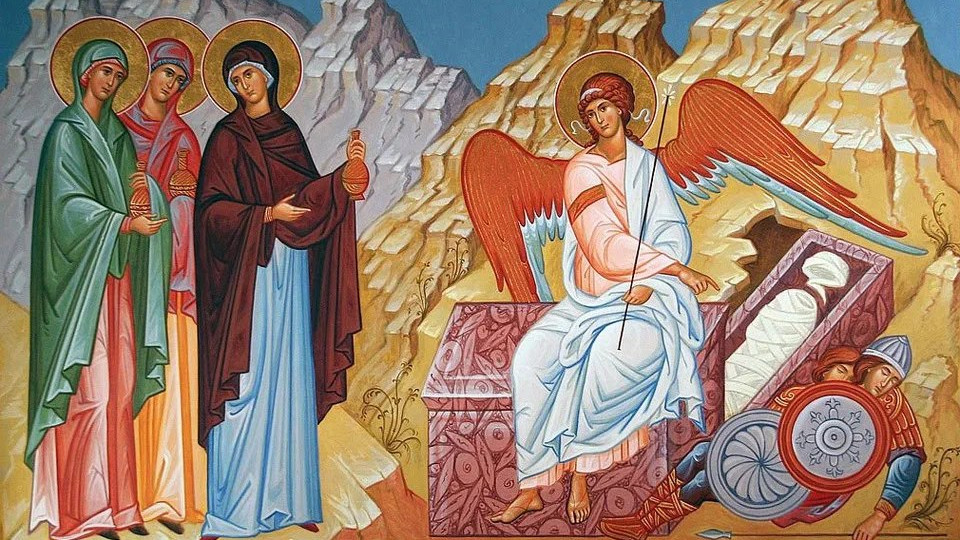
Synaxarion on the Third Sunday of Pascha, of the Holy Myrrh-bearing Women
Verses:
The disciples bring myrrh unto Christ,
and I bring unto them a hymn as myrrh.
On this day, the Third Sunday after Pascha, we celebrate the holy Myrrh-bearing Women. We also commemorate Joseph of Arimathea, who was a secret disciple of Christ, and together with him Nicodemus, the disciple who came by night.
Among them, the women were the true and first witnesses of the Resurrection, while Joseph and Nicodemus were witnesses of the burial—that is, of those things which in our faith are most essential and necessary.
Nicodemus, not consenting with the Jews, was immediately cast out of the synagogue. Joseph, after placing the Lord’s body in the tomb, was cast by the Jews into a pit; yet by divine power he was delivered and returned to his homeland, Arimathea. And Christ, after His Resurrection, appeared unto him while he was in bonds and entrusted to him the whole mystery of the Resurrection. Though he suffered greatly at the hands of the Jews, he did not conceal this mystery in silence, but openly proclaimed what had come to pass. It is also said that Nicodemus, in his writings, set forth before others in detail all that pertained to the Passion and Resurrection of Christ, for being of the synagogue, he knew exactly the intentions, words, and deeds of the Jews.
Therefore they are numbered, together with Joseph, among the true witnesses of the burial, along with the women who beheld the Resurrection, and are commemorated after the assurance of Thomas, since that assurance—having taken place, as the Evangelist says, after eight days (John 20:26)—is appointed to be remembered first. For the women were the first to behold the Resurrection and to announce it to the disciples. It was fitting that the sex which first fell into sin and inherited the curse should first behold the Resurrection and first hear the joy, having first heard: In sorrow shalt thou bring forth children (Gen. 3:16).
They are called Myrrh-bearers for the following reason. When Joseph and Nicodemus, as the Pascha approached—for that Sabbath was a high day (John 19:31)—hastened on Friday to bury the Lord’s body, they anointed it with myrrh according to Jewish custom, but not in the proper manner, for they wrapped it in a winding sheet and laid it in the tomb, placing chiefly myrrh and aloes upon it. Therefore the women, being filled with fervent love for Christ, bought precious myrrh and came by night (both out of fear of the Jews and according to custom) to weep over Him and anoint Him more fittingly, completing what had been left undone for lack of time. When they came, they beheld wondrous visions: two radiant angels within the tomb and another sitting upon the stone. Then they saw Christ and worshipped Him, and Mary Magdalene, supposing Him to be the gardener, inquired of Him concerning Himself.
There were many Myrrh-bearers, but the Evangelists mention only the most prominent. First among them was Mary Magdalene, from whom Christ cast out seven demons (Mark 16:9). According to tradition, she went to Rome after the Ascension of Christ and proclaimed Him to Caesar Tiberius, exposing Pilate and the high priests, and later reposed in Ephesus, where she was buried by John the Theologian. Emperor Leo the Wise later translated her relics to Constantinople. The second was Salome (Mark 15:40), the daughter of Joseph the Betrothed and wife of Zebedee, by whom she bore the Evangelists John and James. For Joseph had four sons—James the Less, Joses, Simon, and Jude—and three daughters—Esther, Tamar, and Salome. Thus, when you hear in the Gospel of Mary, the mother of James the Less and Joses (Mark 15:40), understand that this is the Theotokos, for she was regarded as the mother of Joseph’s children. Hence the Evangelist John is reckoned as a kinsman of Christ. The third Myrrh-bearer was Joanna, the wife of Chuza, steward of King Herod (Luke 8:3). The fourth and fifth were Mary and Martha, the sisters of Lazarus; the sixth was Mary the wife of Cleopas; the seventh was Susanna. And there were many others, as the divine Luke says: “and many others who ministered unto Him of their substance” (Luke 8:3). Since they proclaimed the Resurrection and greatly contributed to its confirmation and firm establishment, the Church of God has received the custom of celebrating them after Thomas, as those who first beheld Christ risen and proclaimed the saving message to all, and who by their manner of life most perfectly followed Christ.
Through the prayers of the holy Myrrh-bearing Women, O God, have mercy on us. Amen.
Редакция сайта www.lavra.ua
Featured

Другие публикации

To signed up and receive Lavra’s emails and important news once a week.
You will be able to unsubscribe from emails at any time.
Spelling error report
The following text will be sent to our editors: