Онлайн трансляция | 12 сентября
Название трансляции
- 12 сентября 2015 Название трансляции
- 12 сентября 2015 Название трансляции
- 12 сентября 2015 Название трансляции
- 12 сентября 2015 Название трансляции
- 12 сентября 2015 Название трансляции
- 12 сентября 2015 Название трансляции
- 12 сентября 2015 Название трансляции
- 12 сентября 2015 Название трансляции
Spirital treasure
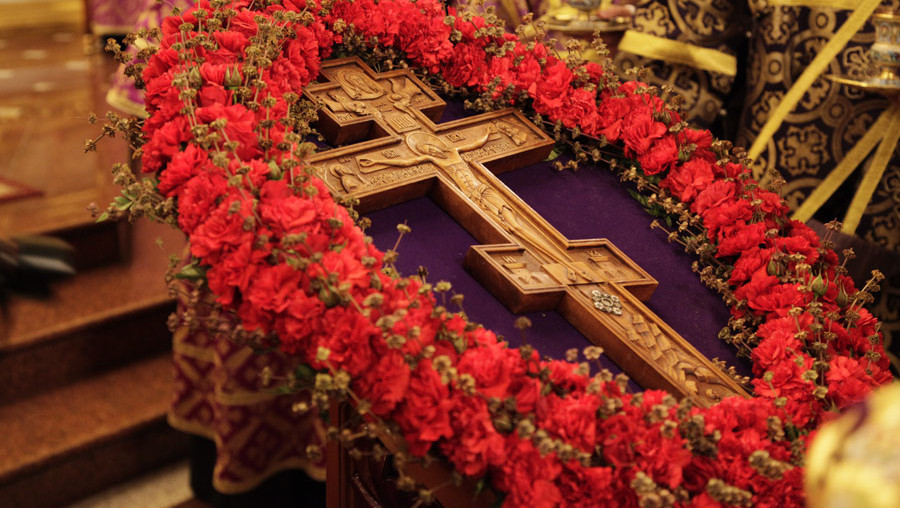
Teaching on the Third Sunday of Great Lent. On Bearing the Cross
“If any man will come after Me, let him deny himself, and take up his cross, and follow Me,” said the Lord to His disciples, having called them before Him, as we heard today in the Gospel.
Beloved brethren! We also are disciples of our Lord Jesus Christ, for we are Christians. We also have been called before the face of the Lord into this holy temple in order to hear His teaching. We stand before the Lord; His gaze is directed toward us. Before Him our souls are laid bare; our secret thoughts and hidden feelings are manifest to Him. He sees all our intentions; He sees the righteousness and the sins committed by us from our youth; He beholds our entire life, both past and future. That which we have not yet done is already written in His book. He foresees the hour of our passage into immeasurable eternity and proclaims to us for our salvation His all-holy commandment:
“Whosoever will come after Me, let him deny himself, and take up his cross, and follow Me.”
By the power of living faith let us lift up the eye of our mind toward the Lord—and we shall behold Him, behold Him Who is everywhere present, Who is here with us! Let us open our heart, rolling away from its entrance the heavy stone of hardness. Let us hear, examine, accept, and make our own the teaching of our Lord.
What does it mean to deny oneself?
To deny oneself means to abandon a sinful life. Sin, through which our fall occurred, has embraced our whole nature so completely that it has become as though natural to us. Thus renunciation of sin becomes renunciation of our fallen nature; and renunciation of our fallen nature is renunciation of ourselves.
Eternal death, which struck our soul, has become for us life. It demands its food—sin; its delight—sin. By such food and delight eternal death maintains its dominion over man. Yet fallen man considers the development of this dominion of death within himself to be the development and progress of life.
Thus a person afflicted with a deadly illness is driven by the violent demands of that illness and seeks the very foods that increase the sickness, seeking them as the most necessary nourishment and the sweetest pleasure.
Against this eternal death, which appears as life to fallen humanity, the Lord pronounces His judgment:
“Whosoever will save his life,” that is, whoever develops within himself the life of the fall—eternal death—“shall lose it; but whosoever shall lose his life for My sake and the Gospel’s, mortifying sinful desires and renouncing sinful pleasures, shall save it.”
Pointing to the whole world before our eyes, with all its beauty and charm, the Lord says:
“What shall it profit a man if he gain the whole world and lose his own soul?”
What benefit would it be for a man, even if he possessed not something insignificant but the entire visible world? This visible world is only a temporary lodging for man! There is nothing on earth that we can truly call our own. All is taken from us by relentless and inevitable death, and often even before death by unforeseen circumstances and upheavals.
Even our body we lay aside upon the threshold of eternity.
Our true possession, our treasure, is our soul—our soul alone.
“What shall a man give in exchange for his soul?”
There is nothing with which we can repay the loss of the soul when eternal death destroys it.
What does it mean to take up one’s cross?
The cross was an instrument of shameful execution for criminals and captives deprived of civil rights. The proud world, hostile to Christ, deprives the disciples of Christ of the rights enjoyed by the sons of the world.
“If ye were of the world,” says the Lord, “the world would love its own; but because ye are not of the world, but I have chosen you out of the world, therefore the world hateth you.”
“They shall put you out of the synagogues; yea, the time cometh, that whosoever killeth you will think that he doeth God service.”
To take up one’s cross means to endure with magnanimity the mockery and reproaches with which the world covers the follower of Christ, the sorrows and persecutions with which the sin-loving and blinded world pursues the follower of Christ.
“For this is acceptable with God,” says the Apostle Peter, “if a man for conscience toward God endure grief, suffering wrongfully. For unto this were ye called,” by the Lord Who told His beloved ones:
“In the world ye shall have tribulation; but be of good cheer; I have overcome the world.”
To take up one’s cross also means courageously to endure the invisible labor, the hidden suffering and martyrdom required by the struggle against our passions, the sin dwelling within us, and the spirits of wickedness which rise up fiercely against us when we resolve to cast off the yoke of sin and submit ourselves to the yoke of Christ.
“For we wrestle not against flesh and blood,” says the Apostle Paul, “but against principalities, against powers, against the rulers of the darkness of this world, against spiritual wickedness in high places.”
“Our weapons are not carnal, but mighty through God to the pulling down of strongholds, casting down imaginations and every high thing that exalteth itself against the knowledge of God.”
Having gained victory in this invisible but difficult struggle, the Apostle exclaimed:
“God forbid that I should glory, save in the cross of our Lord Jesus Christ, by whom the world is crucified unto me, and I unto the world.”
To take up one’s cross also means humbly to submit to the temporal sorrows and trials which Divine Providence allows for the purification of our sins.
Then the cross becomes for man a ladder from earth to heaven.
By this ladder the thief mentioned in the Gospel ascended from terrible crimes into the radiant dwellings of Paradise. From his cross he uttered words full of humility; through humility he came to knowledge of God; through knowledge of God he gained heaven.
“We receive the due reward of our deeds; remember me, O Lord, when Thou comest into Thy Kingdom.”
And we also, beloved brethren, when sorrows surround us, should repeat the words of the thief—words whose price is Paradise.
Or like Job we shall bless the Lord who chastens us:
“Shall we receive good at the hand of God, and shall we not receive evil? Blessed be the Name of the Lord.”
May the unfailing promise of God be fulfilled for us:
“Blessed is the man that endureth temptation: for when he is tried, he shall receive the crown of life.”
To take up one’s cross also means willingly to submit to the labours and deprivations that restrain the irrational impulses of our flesh.
The Apostle Paul himself practiced such crucifixion of the body:
“I discipline my body and bring it into subjection, lest, having preached to others, I myself should become disqualified.”
“They that are in the flesh cannot please God.”
Therefore while living in the flesh we must not live for the flesh.
“If ye live according to the flesh, ye shall die; but if through the Spirit ye mortify the deeds of the body, ye shall live.”
The flesh is subdued by the spirit when it is prepared for obedience through crucifixion—through fasting, vigil, prostrations, and other bodily labours undertaken with wisdom and moderation.
“They that are Christ’s,” says the Apostle, “have crucified the flesh with the passions and lusts.”
What does it mean to take up one’s own cross?
It means that every Christian must patiently endure precisely those reproaches and persecutions that befall him—not others imagined by prideful fantasy.
It means to struggle with the particular passions and sinful thoughts that arise within him.
It means to bear with humility those sorrows and trials permitted by Divine Providence.
Indeed, every man has his own cross.
Only he who accepts his own cross with self-denial can truly follow Christ.
What does it mean to follow Christ?
It means to study the Gospel and make it the sole guide for the activity of our mind, heart, and body.
It means to form our thoughts according to the Gospel, to tune our feelings according to the Gospel, and to express the Gospel in all our actions.
Beloved brethren!
As today we bow before the precious Cross of the Lord according to the rule of the Church, let us also bow before it in spirit.
Let each of us from his own cross say:
“I receive the due reward of my deeds. Remember me, O Lord, in Thy Kingdom.”
By acknowledging our sinfulness, thanking God, and submitting to His will, we shall transform our cross—once an instrument of shame—into a banner of victory.
Let us not allow harmful murmuring, and especially not blasphemy, which often pours from the lips of the hardened sinner struggling upon his cross.
For through murmuring the cross becomes unbearable and drags a man into hell.
But our Lord Jesus Christ willingly ascended the Cross and endured death in order to reconcile mankind to God.
Preparing His apostles for the redemption of mankind through His suffering and death, the Lord told them that He must suffer, be killed, and rise again.
And then He said:
“If any man will come after Me, let him deny himself, take up his cross, and follow Me.”
Редакция сайта www.lavra.ua



To signed up and receive Lavra’s emails and important news once a week.
You will be able to unsubscribe from emails at any time.
Spelling error report
The following text will be sent to our editors: