Онлайн трансляция | 12 сентября
Название трансляции
- 12 сентября 2015 Название трансляции
- 12 сентября 2015 Название трансляции
- 12 сентября 2015 Название трансляции
- 12 сентября 2015 Название трансляции
- 12 сентября 2015 Название трансляции
- 12 сентября 2015 Название трансляции
- 12 сентября 2015 Название трансляции
- 12 сентября 2015 Название трансляции
articles
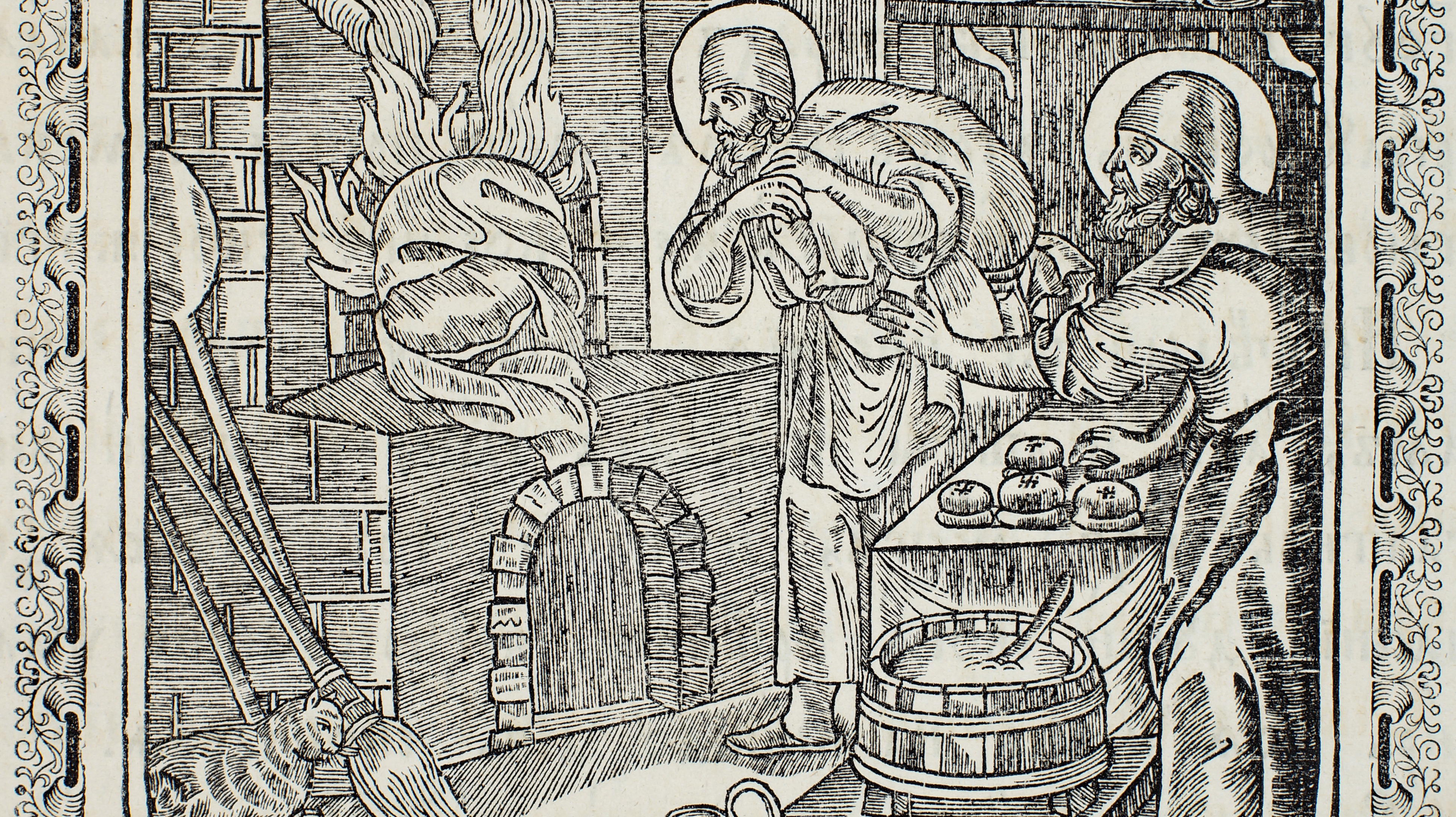
Venerable Nicodemus and Spyridon of the Kyiv Caves — our guides in labour and prayer
The life of the venerable Nicodemus and Spyridon, prosphora-bakers of the Kyiv-Caves Lavra, remains a living lesson for every Christian. Humble in origin, they came to the monastery not with book learning but with a fervent desire to please God and a readiness to embrace obedience. These modest monks, who devoted themselves to a simple yet sacred task — the baking of prosphora for the Holy Eucharist — reveal how ordinary work, when joined with ceaseless prayer, can raise a person heavenward. For prayer and labour are the two wings by which the soul ascends to God, overcoming the weight of earthly cares.
The life of the venerable Spyridon and Nicodemus offers us many lessons.
Firstly, they teach us to unite labour with prayer.
Labour disposes the heart to prayer and is strengthened by it; and prayer inclines the soul to work and is stirred by it.
Once Saint Anthony the Great, while contending in the desert with his thoughts, cried out from the depths of his heart: “Lord, show me the way of salvation!” Moved by a certain inner prompting, he came forth from his cave and saw someone like himself, who sat and worked, then rose to pray; afterwards he again sat and wove a rope; having worked, he stood once more for prayer. This was an Angel of the Lord, sent to instruct and strengthen Anthony. The Angel of God said aloud to him: “Do thus, and thou shalt be saved.”
“Labour strengthened by prayer, and prayer accompanied by good works, can bring salvation to the soul; for this, above all, should those who labour strive.” (Sayings of the Desert Fathers)
Secondly, the life of the venerable Spyridon and Nicodemus, far removed from idleness, teaches us to shun idleness as the most perilous state for a Christian.
“Idleness or sloth is in itself sin, for it is contrary to the commandment of God,” teaches Saint Tikhon of Zadonsk. “To our forefather Adam it was said by God: ‘In the sweat of your face you shall eat bread, till you return to the ground, for out of it you were taken’” (Genesis 3:19, NKJV).
This commandment concerns us also, the sons of Adam. And the holy Apostle likewise forbids idleness, saying that if anyone will not work, neither shall he eat (cf. 2 Thessalonians 3:10). Therefore those who live in idleness and feed on the labours of others sin continually, and will not cease from sin until they give themselves over to blessed toil. The infirm and the aged are excepted, who though they might wish to work, are unable.
The human heart can never be idle but is always occupied with some thought. Thus, the soul’s adversary, the devil, readily approaches an idle heart — as to an empty house — and fills it with evil thoughts, like harmful weeds, and teaches it to bring them to action.
Hence idleness causes many iniquities: from it come drunkenness; from it all manner of impurity; from it arise evil talk, gossip, and mockery; from it frequent feasts, thefts, robberies, perjuries; from it card games and their inseparable companions — deceit, disorder, quarrels, strife, and other transgressions. Idleness teaches one to steal, to lie, to flatter, and to deceive, for the idle person, having nothing to live by, seeks to take the fruits of others’ labour, whether openly, secretly, or by cunning. Thus, “idleness teaches much evil,” in the words of the wise Sirach (Sirach 33:28).
Therefore, beloved brethren, let us learn from our venerable fathers Nicodemus and Spyridon their love of labour and their avoidance of idleness, their diligence in prayer during work. Let us especially delight in singing sacred hymns instead of the vain, pitiful, and immoral songs of the world. Finally, let us learn from them fidelity in keeping the rites prescribed by the Church (even in the folding of the fingers for the sign of the Cross.
When the relics of Saint Spyridon of the Caves were discovered, it was found that the fingers of his right hand were arranged in the form of the sign of the Cross — precisely as the Church teaches Orthodox Christians to bless themselves: three fingers (the thumb, forefinger, and middle) joined together in honour of the Holy Trinity, while the other two (the ring finger and the little finger) are pressed to the palm, as a testimony to the two natures of our Lord Jesus Christ — Divine and human.
Thus, the very incorrupt body of the Saint serves as a living instruction: even after death, he seems to continue teaching us how to make the sign of the Cross rightly.
This is not a mere outward coincidence, but a visible expression of his inner faithfulness to the Church and his love for prayer.
Редакция сайта www.lavra.ua
Featured

Другие публикации

To signed up and receive Lavra’s emails and important news once a week.
You will be able to unsubscribe from emails at any time.
Spelling error report
The following text will be sent to our editors: