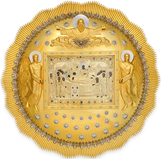
Онлайн трансляция | 12 сентября
Название трансляции
- 12 сентября 2015 Название трансляции
- 12 сентября 2015 Название трансляции
- 12 сентября 2015 Название трансляции
- 12 сентября 2015 Название трансляции
- 12 сентября 2015 Название трансляции
- 12 сентября 2015 Название трансляции
- 12 сентября 2015 Название трансляции
- 12 сентября 2015 Название трансляции
Hagiography

Saint Filaret of Kyiv and the Kyiv-Pechersk Lavra
“Set an example for the faithful in speech, in conduct, in love, in spirit, in faith and in purity” (1 Tim. 4:12).
In the nineteenth century, people spoke of two distinguished men named Philaret: Philaret the Wise and Philaret the Pious. The first epithet referred to St Philaret (Drozdov), an outstanding theologian and preacher. The second belonged to St Philaret (Amphiteatrov), whose life became an example of profound piety, monastic humility and active love for one’s neighbour.
Bishop Philaret (born Theodore Georgievich Amphiteatrov, and known as Theodosius after receiving the Great Schema) had longed for the monastic life from his youth. In 1798, he received the monastic tonsure and was given the name Philaret. From then on, monasticism became the foundation of his inner spiritual life. In time, the Lord entrusted him with positions of great responsibility in the Church: he served as an abbot, archimandrite, bishop and archbishop, before becoming Metropolitan of Kyiv and Galicia. Yet neither his pastoral responsibilities nor his position in the Church diminished his desire for solitude, prayer and the practice of the monastic life.
St Philaret was appointed Metropolitan of Kyiv and Galicia in 1837. The final period of his life was associated with Kyiv and perhaps revealed his spiritual character more fully than any other. The Metropolitan devoted much attention to the Kyiv-Pechersk Lavra and its monastic brotherhood. He also made the Holosiiv Hermitage, near Kyiv, his summer residence. There, away from the constant demands of diocesan administration, he could devote himself to prayer, spend time with experienced ascetics and continue his own monastic labours.
The Venerable Parthenius of Kyiv (Krasnopevtsev) held a special place in the Metropolitan’s life. In 1838, the Metropolitan personally tonsured Pafnuty, a hieromonk of the Lavra, into the Great Schema, giving him the name Parthenius. He subsequently chose the elder to be his spiritual father. The Metropolitan treated the elder with the deepest respect, without allowing his own episcopal dignity to stand in the way. Knowing of the Venerable Parthenius’s ardent love of solitude, he relieved him of his duties at the Lavra and provided him with a cell of his own. Later, he invited him to live at his summer residence in Holosiiv.
On one occasion, the Venerable Parthenius lamented that he was not experiencing the outward persecutions endured by the ascetics of ancient times. St Philaret, who had himself undergone many trials in his youth, comforted him with a smile:
“Why do you need persecution? You persecute yourself; who nowadays would wish to live as you do?”
These words reveal a profound understanding of the monastic struggle. It is not outward trials in themselves that make someone an ascetic, but the unceasing struggle against one’s passions, renunciation of self-indulgence and willingness to endure hardship for Christ’s sake. The Metropolitan understood that the Venerable Parthenius’s life was already filled with deprivation, prayerful labour and inner struggle, even without external persecution.
In August 1841, the elder Parthenius secretly tonsured his spiritual son into the Great Schema, giving him the name Theodosius. Although the Metropolitan already held one of the highest ranks in the Church, he wished to devote himself even more fully to prayer and the monastic life. This secret tonsure testified to the fact that his inner desire for monastic perfection remained his foremost concern throughout his life.
The Metropolitan also had an extraordinary relationship with the Venerable Theophilus of Kyiv, a holy fool for Christ’s sake. Initially, the bishop, who was disciplined and meticulous in administrative matters, found it difficult to understand this ascetic, whose appearance was unkempt and whose manner could be abrupt. His unusual actions were not always easy to interpret. Over time, however, the Metropolitan’s perplexity gave way to profound respect and affection.
A turning point came when Theophilus foretold a fire at the Kyiv-Pechersk Lavra. One day, when he encountered the Metropolitan, the blessed ascetic did not offer his usual greeting but instead threw a charred piece of wood at his feet. Soon afterwards, a fire did indeed break out at the Lavra. The bishop recognised this as evidence of the elder’s gift of foresight and began to place particular trust in him.
Another account of their encounters has also been preserved. On one occasion, the Metropolitan was travelling on urgent business through the Kitaiv Forest and had not yet finished his morning prayer rule. Suddenly, he saw Theophilus sitting in a tree with a prayer book.
“What are you doing up there?” the bishop asked.
“I am finishing my prayer rule. It’s always one journey after another, and there’s never any time to pray,” the holy fool replied.
The Metropolitan understood that the blessed ascetic’s words were also directed at him. Despite his many pastoral responsibilities, he tried not to neglect his prayers. Nevertheless, this encounter reminded him how easily even necessary work can take away the time intended for communion with God.
Afterwards, the bishop took particular care of Theophilus. He defended him against complaints, invited him for spiritual conversations and sought to provide him with the conditions needed for a life of solitude and ascetic struggle. He even attempted to arrange for the blessed ascetic to live with the Venerable Parthenius at the summer residence in Holosiiv. Theophilus, however, could not remain in such peaceful surroundings for long and soon returned to his customary life at the Kitaiv Hermitage. The bishop came to see him not as an eccentric who needed correcting, but as an ascetic whose spiritual path was not always understood by those around him.
Among those for whom the Metropolitan showed particular care was the future Venerable Paisius of Kyiv, a holy fool for Christ’s sake, who had been given the name Prokopii Yarotsky at birth. In the early 1850s, he pursued the ascetic life at the Kyiv-Pechersk Lavra and was later transferred to the Holosiiv Hermitage, where he was entrusted with reading the Metropolitan Philaret’s daily prayer rule. In 1854, with the bishop’s blessing, Prokopii received the rassophore tonsure and was given the name Paisius.
Father Paisius led an exceptionally austere life. He wore worn-out clothes, slept wherever he could, lived on the scantiest of food and endured ridicule and insults. His behaviour often bewildered those around him, and the monastery authorities sometimes regarded it as a sign of mental disturbance. St Philaret, however, was reluctant to judge the ascetic by his appearance. He blessed his monastic path, supported him and defended him against unjust treatment. The Metropolitan gave him alms, humbly asking for his holy prayers in return.
These relationships reveal another characteristic of the saint: his ability to see beyond a person’s outward appearance and recognise their inner longing for God. He did not condone every unusual behaviour, but neither was he quick to reject someone whose ascetic life did not fit conventional expectations. Having himself received the Great Schema, the Metropolitan knew that the work of inner spiritual transformation was hidden from the eyes of others, and that it was dangerous to judge a person’s spiritual state solely by outward appearances.
The saint’s strictness towards himself was accompanied by extraordinary kindness towards others. He gave his own money to those in need, supported the poor, cared about spiritual education and tried never to turn away from another person’s suffering. For him, mercy was not merely one duty among the many responsibilities of a bishop; it was the natural fruit of prayer and love for Christ.
This love was especially evident in the account of the healing of the boy Vladimir Shepelev, who would later become the Venerable Alexis of Holosiiv. The boy had been born unable to speak, and his parents were deeply distressed by his condition. Metropolitan Philaret knew the Shepelev family, helped them and supported the boy’s mother, Maria Kuzminichna. Whenever she came to the bishop in her grief over her son’s condition, he comforted her and urged her not to lose hope in God’s mercy, but to pray more fervently and give alms.
Easter 1853 was approaching. The saint blessed Maria Kuzminichna to bring her son to the evening service at his private chapel, dedicated to St Mitrophan of Voronezh. The pious mother placed her hope in God and in the prayers of her archpastor.
After the service, the faithful came forward to venerate the Cross held by the bishop. When Maria Kuzminichna and her son reached him, the saint blessed them and instructed the boy to kiss his episcopal staff as well. He then greeted the child with the traditional Paschal greeting:
“Christ is risen!”
Vladimir remained silent. The saint repeated the greeting a second time, but the boy still did not answer. Then, for the third time, the bishop proclaimed loudly:
“Christ is risen!”
And then something happened for which the distressed mother had waited so long. The boy suddenly replied clearly and joyfully:
“He is risen indeed!”
These were the first words Vladimir had ever spoken. According to his Life, from that moment he was able to speak. His mother was overcome with amazement and did not know how to express her gratitude to God for the miracle. The saint, having given thanks to the Lord, withdrew into the altar.
The bishop’s care for the boy did not end with his healing. He understood that the child needed not only to regain his health but also to receive a good education and upbringing that would help him find his place in life. With the Metropolitan’s blessing, on 2 July 1853, thirteen-year-old Vladimir entered the Kyiv-Pechersk Lavra as a novice.
Four days later, the boy’s mother died, leaving Vladimir an orphan. The saint took responsibility for his future. Thanks to the Metropolitan’s care, the boy received a sound spiritual and secular education. The bishop arranged for teachers from the Kyiv Theological Academy and the university to help educate him. Yet moral formation was even more important. The Metropolitan taught Vladimir prayer, obedience and mercy, showing by his own example how one should treat the poor and the infirm.
Vladimir later received the monastic tonsure with the name Alexis and became known as the Venerable Alexis of Holosiiv, an elder and spiritual father of the Kyiv-Pechersk Lavra. Thus, the saint’s care for the boy, which had begun with prayer for his healing, continued through the spiritual formation of the future ascetic.
The saint’s Life preserves another account of his mercy. On one occasion, while visiting a family, the bishop addressed the hosts’ daughter, who was unable to utter a word because of an unidentified illness.
“And what is your name, dear child?” he asked.
The girl replied in a clear voice:
“Masha!”
From that moment onwards, she was able to speak. Accounts such as these have preserved the memory of the saint as a man in whom a life of concentrated prayer was united with heartfelt kindness and attentiveness to the needs of others.
The final years of the bishop’s life were overshadowed by serious illnesses, yet he continued to fulfil his pastoral ministry, receive visitors, guide the brotherhood and remain faithful to his prayer rule. On 21 December 1857, according to the Julian calendar, St Philaret reposed in the Lord after receiving the Holy Mysteries of Christ.
The saint’s life brought together, in a remarkable way, high ecclesiastical office and the profound humility of a monk, strictness towards himself and forbearance towards others, the solitude of prayer and active love. He did not separate his inner spiritual struggle from his care for people, did not consider his rank a reason to expect honours, and was himself ready to learn from those whom others might fail to understand.
The memory of St Philaret of Kyiv preserves the image of an archpastor who, amid countless responsibilities, never lost sight of what mattered most: remaining faithful to Christ. His life reminds us that true monasticism consists not merely in outward solitude and austerity, but above all in the state of the heart—in repentance, humility, obedience to God and love expressed through active care for one’s neighbour.
Through the prayers of St Philaret, may the Lord strengthen all who have chosen the monastic path and help each of us to seek not our own glory, but the fulfilment of His holy will.
Редакция сайта www.lavra.ua
Featured


Другие публикации

To signed up and receive Lavra’s emails and important news once a week.
You will be able to unsubscribe from emails at any time.
Spelling error report
The following text will be sent to our editors: